
If you sell courses, coaching, or a paid community, your payment processor isn’t just a fee line item. It’s the thing standing between a buyer’s “yes” and money actually landing in your account. Get it wrong and you lose sales to declined cards, abandoned checkouts, and buyers who can’t afford your price in one lump sum.
Most “best payment processor” lists compare Stripe, Square, and PayPal like every business is the same. A coffee shop and a coach selling a $2,000 program don’t have the same problem. Coaches and course creators deal with high-ticket prices, payment plans, upsell funnels, affiliates, and buyers who are deciding in the moment on a webinar or sales call.
This list is built around that reality. It’s ranked by fit for creators specifically, not general small business use. Here’s the case for each option, starting with the one we think wins for most course and coaching businesses: Commas.
Commas (formerly FanBasis, rebranded in July 2026) is a sales and payments platform built specifically for online creators, coaches, and course sellers. Instead of gluing together a course host, a checkout tool, a community app, and a separate payment processor, Commas puts checkout, funnels, courses, communities, webinars, invoicing, and affiliate tracking on one account, with payments built into all of it rather than bolted on.
Who it’s for: Coaches and course creators who sell more than a single low-ticket product, run webinars or sales calls as part of the funnel, want payment plans or financing on higher-ticket offers, or are tired of paying for four separate tools that don’t talk to each other.
Commas doesn’t publish a flat public rate card the way Stripe or Square do. Pricing is account-based and scales with your volume, which is worth knowing going in: you’ll want to open an account or talk to their team to get your actual rate rather than assuming a number. That’s a real difference from the “2.9% + 30 cents, that’s it” simplicity of Stripe or Square, and it’s worth factoring in if you value knowing your exact cost before you sign up.
For a coach or course creator running an actual funnel (webinar, sales call, upsells, payment plans, affiliates), Commas solves problems that a raw payment processor like Stripe simply doesn’t touch. The case for it isn’t “cheaper fees.” It’s “fewer tools, fewer leaks, more of what you already sold actually gets collected.”
Open a Commas account through this link → [INSERT YOUR COMMAS AFFILIATE LINK HERE]
Who it’s for: Coaches who invoice clients directly for one-on-one work, or who want the brand recognition to boost trust at checkout.
Widely trusted, solid invoicing tools, good for service-based coaching businesses that bill clients directly rather than running self-serve checkout.
PayPal has a well-documented pattern of placing holds on funds when a seller’s transaction volume or pattern shifts unexpectedly, which is worth knowing if you run occasional high-ticket launches rather than steady recurring billing. It also has no real funnel, upsell, or course-hosting functionality of its own.
Kajabi is a course-hosting platform with email marketing, landing pages, and payments (processed through Stripe under the hood) built into one subscription.
Creators whose main need is a polished course-hosting experience with email marketing baked in, and who are fine with a monthly software subscription on top of processing fees.
Course hosting, funnels, email marketing, and a native checkout that runs on top of Stripe.
Strong course delivery experience, marketing automation is genuinely useful for creators who don’t want a separate email tool.
Because Kajabi’s payments run through Stripe rather than its own routing system, you don’t get the failed-payment recovery or multi-processor routing that platforms like Commas build in. You’re also paying a recurring platform subscription on top of processing fees, and pricing tiers restrict features like removing Kajabi branding or advanced automations to higher plans.
ThriveCart is a checkout and cart platform with a one-time purchase price instead of a monthly subscription, which has made it popular with creators who want to avoid recurring software costs.
Creators who already have course hosting sorted out elsewhere and just want a strong checkout and upsell page builder without another monthly bill.
A single upfront cost (roughly $495 for the standard plan, based on current public pricing) instead of a monthly fee, connecting to your own Stripe or PayPal account for actual processing.
No recurring software fee, strong cart and upsell page builder.
ThriveCart doesn’t process payments itself. It connects to accounts you already have with Stripe or PayPal, so you’re still paying those processors’ standard rates and still managing a separate course-hosting tool if you don’t already have one.
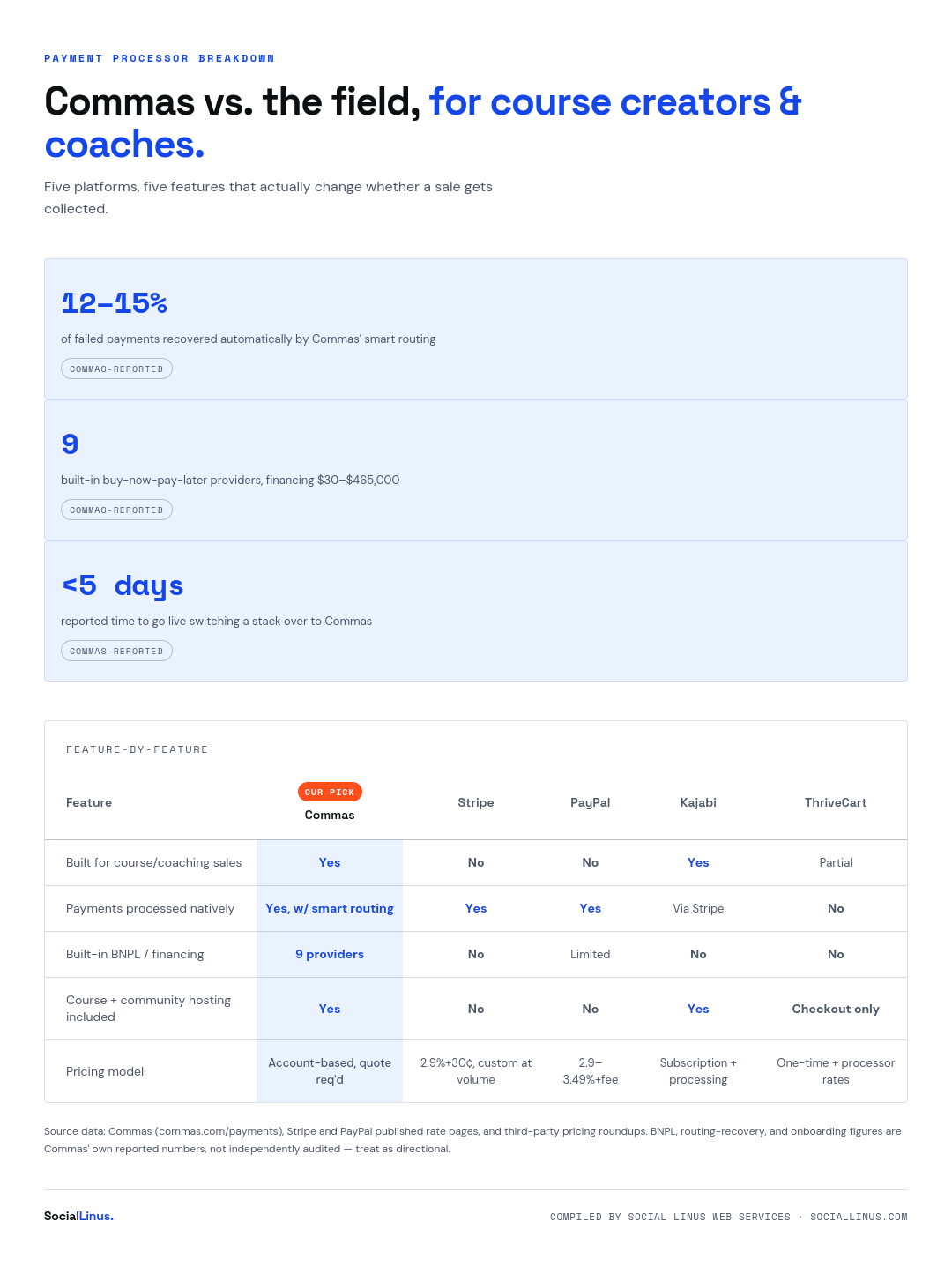
Both. It’s built as a single account that combines checkout, courses, communities, webinars, and payment processing with smart routing between processors, rather than being just one piece of that stack.
No. Commas is designed to handle payment processing itself, including routing transactions across multiple processors behind the scenes, so you don’t need to separately maintain a Stripe or PayPal account for it to work.
It can be, but the strongest case for switching is when you have an actual funnel: a webinar, a sales call, upsells, or payment plans on a higher-ticket offer. If you’re only selling one $27 product with no funnel behind it, a simpler tool might be enough for now.
FanBasis rebranded to Commas in July 2026. It’s the same company and platform under a new name, with an expanded feature set for creators, coaches, and course sellers.
Commas doesn’t publish a flat rate the way Stripe and PayPal do, so a direct percentage comparison isn’t possible from public information. The stronger case for Commas isn’t a lower headline rate. It’s fewer tools, embedded checkout through the whole funnel, and automatic recovery of failed payments, which affects how much of what you sell you actually collect.
If you’re comparing processors purely on advertised rate, Stripe and Square are the simplest to understand at a glance. But rate isn’t the whole cost of running a course or coaching business online. The real cost is every tool you’re paying for separately, every failed payment you never follow up on, and every buyer who bounces because there’s no option to split the cost of a $2,000 program. For creators running an actual sales funnel, Commas is built to close those gaps in one account instead of five. That’s the case for making it your first stop before you commit to stitching together Stripe, a course host, a community app, and a checkout builder on your own.