
A homeowner reads your water heater replacement page and closes the tab. No call. No form. Direct mail retargeting for home services is a way to follow up with that household by mail a few days later, with a postcard that carries a tracked phone number and a QR code.
This guide is for owners deciding whether to try it. We cover what it is, why it suits home service work, how it runs step by step, what it costs with real numbers, who it fits, and what to ask any provider before you sign. Near the end, we show where SignalForge, the direct mail follow-up service we run at Social Linus, fits in.
What Is Direct Mail Retargeting?
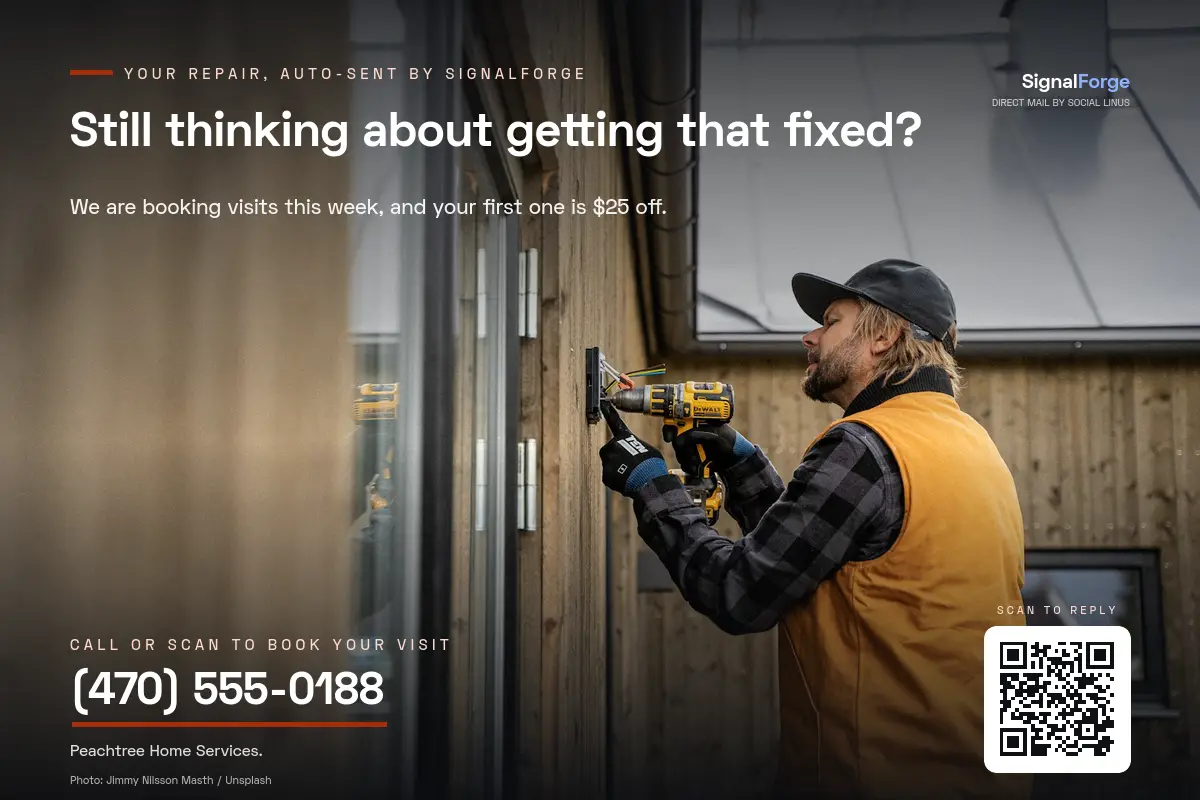
Direct mail retargeting mails a printed piece to people who visited your website and left without contacting you. A script on your site records which pages a visitor viewed. When that visitor leaves without converting, the system tries to match them to a mailing address and sends a postcard.
Online retargeting follows a visitor with ads. Direct mail retargeting follows them with something they hold in their hand. For a fuller definition, read our glossary entry on what direct mail retargeting is and how it works.
Why Direct Mail Fits Home Services
Plenty of businesses can mail their website visitors. Home service companies have a few reasons to take a closer look.
The jobs are big. A roof, a new HVAC system, a sewer line or a bathroom remodel can be one of the larger checks a household writes in a year. When one booked job can cover many months of a marketing cost, a follow-up that costs about a dollar per postcard, plus data, can be worth testing.
You sell to households, and the address is the job site. A software company mailing a visitor has to guess whether that person works from home. A plumber mailing a homeowner is sending the postcard to the same address where the work would happen. The mailing address and the customer location are usually one and the same.
Homeowners take time to decide. People rarely book a big repair on the first visit to a contractor’s site. They compare quotes and talk it over at home first. A postcard that lands during that window gives them a reminder with your number on it.
The postcard sits on the counter. An ad disappears when the page scrolls. A 6×9 postcard can stay on the kitchen counter or the fridge until the homeowner is ready to call.
What response rates look like for direct mail in general
Published direct mail response rates disagree, and many of the popular figures trace back to each other. Our source-traced direct mail response rate benchmarks suggest planning a cold prospect list at roughly 1 to 3 percent response, and a list of existing customers higher than that. That is a planning range, not a measured average. It does not predict results for retargeting or for your company. Your own tracked numbers are the only figures that matter for your budget.
How Direct Mail Retargeting for Home Services Works, Step by Step
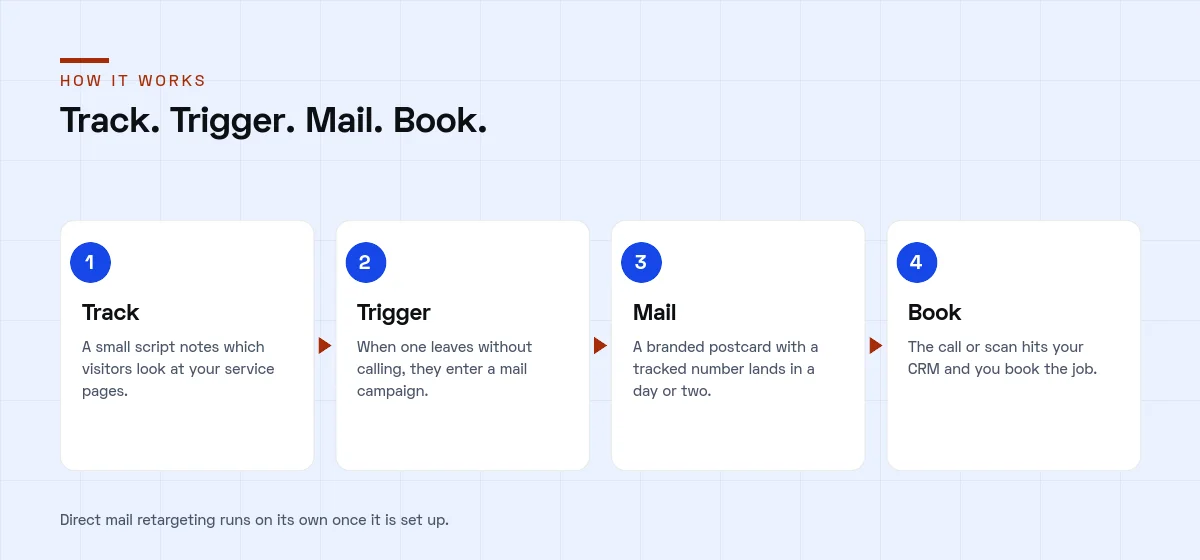
Most direct mail retargeting setups follow the same basic path. Here is how it runs at Social Linus.
1. Track. A small script on your website notes which pages each visitor looks at. A visit to your “AC repair” page tells you something different from a visit to your careers page.
2. Trigger. When someone views a service page and leaves without calling, the system tries to match that visitor to a mailing address. Matching is imperfect. Plan around these identification rates:
- About 20 to 25 percent of residential visitors on the base data setup
- 60 to 70 percent of residential visitors with a premium data match
- 25 to 35 percent of business visitors
The data type is chosen per campaign. The rest of your visitors stay anonymous, and no honest provider can mail them. If you want the background, our explainer on how visitors get matched to an address covers it.
3. Mail. A 6×9 postcard goes out with a QR code and a phone number that exists only for that campaign. When the phone rings on that number, you know the postcard made the call. First class postcards arrive in about 3 to 5 business days after USPS receives them. Marketing mail takes about 7 to 21.
4. Book. The scan or call lands in your CRM, and a follow-up sequence starts so the lead gets a fast response from your team.
Speed matters at step 4. A homeowner who scans the QR code at 7 p.m. is ready to talk then. If nobody calls back until the next afternoon, the postcard did its job and the follow-up did not.
What Direct Mail Retargeting Costs
The total cost has three parts. Ask any provider to show you all of them separately.
1. The service or plan fee. It typically covers tracking, matching setup, the campaign build and the CRM connection. It is usually a setup fee plus a monthly fee.
2. The postcards. Each piece has a print and postage cost. At Social Linus, postcards are never included in a plan. They are paid from prepaid mail credits funded by your own budget. Here is what each 6×9 postcard costs, by how many credits you buy at once:
| Purchase | First class | Marketing mail |
|---|---|---|
| Flex (100 to 2,499) | $1.13 | $1.07 |
| Growth block (2,500) | $1.09 | $1.03 |
| Scale block (5,000) | $1.05 | $0.99 |
| Summit block (10,000) | $1.01 | $0.95 |
The overall range is $0.95 to $1.13 per postcard. Done With You pays the Flex price at any volume. 500 postcards run about $535 to $565. Credits expire 12 months after purchase. Letters, self-mailers and other sizes are on our mail price list.
3. The visitor data. Matching a visitor to an address has a cost. We bill visitor data per visitor named, at cost, up to a monthly lead budget you set. You decide the ceiling.
For a wider look at print and postage pricing outside retargeting, see our guide to how much direct mail costs per piece. For general background on mailing as a channel, the USPS has a page on direct mail advertising for businesses.
A worked example (illustration only)
This is an illustration built from our published prices. It is not a quote and it does not predict results.
Say a home service company picks the Done For You plan and buys 500 first class postcards, which fall in the Flex block.
| Line item | Cost |
|---|---|
| Done For You setup (one time) | $3,610 |
| Done For You monthly fee | $461 |
| 500 first class postcards at $1.13 | $565 |
| Visitor data | At cost, up to the monthly budget you set |
| First month, before visitor data | $4,636 |
If the same company chose marketing mail, the 500 postcards would cost $535 at $1.07 each, and the first month before data would be $4,606.
A smaller start looks like this. On Done With You with the Embers™ add-on, setup is $1,550 plus $306, the monthly fee is $152 plus $154, and 500 first-class postcards add $565. That comes to $2,727 for the first month before visitor data, then $306 a month plus postcards and data.
How many visitors does 500 postcards cover? With one postcard per matched household, and 20 to 25 percent of residential visitors matched on the base data setup, 500 postcards line up with about 2,000 to 2,500 residential visitors who viewed a service page and left. With a premium data match at 60 to 70 percent, the same 500 postcards line up with roughly 715 to 835 of those visitors. Because credits last 12 months, a lower-traffic site can use a block over several months.
The real test is your own math. Take your average job value and your gross margin, and work out how many booked jobs it would take to cover the first few months. Our leak calculator for direct mail ROI lets you plug in your own traffic and job value to see what may be slipping away.
Who Direct Mail Retargeting Fits, and Who Should Skip It
Direct mail retargeting can make sense if you check all of these boxes:
- You get at least a few hundred website visitors a month. Matching only reaches part of your traffic, so you need enough visitors for the matched share to add up.
- Your average job is big enough. A postcard costs about a dollar plus data. That math works better for a water heater install than for a one-time drain cleaning special.
- Someone answers the phone. A tracked number that rings into voicemail all afternoon wastes the postcard.
- Your customers are in the US. Address matching and mailing here are built for US households and businesses.
It is a poor fit if:
- Your site gets very little traffic. There will be too few matched visitors to learn anything.
- Most of your customers are outside the US.
- Your jobs are small and one-time, with little repeat work.
- Nobody on your team can follow up on calls and scans within a business day.
If traffic is the problem, fix that first. More visitors from search can do more for you than mailing a small number of them. Our local search and AI search service is where we would start in that case.
How to Judge Any Direct Mail Retargeting Provider
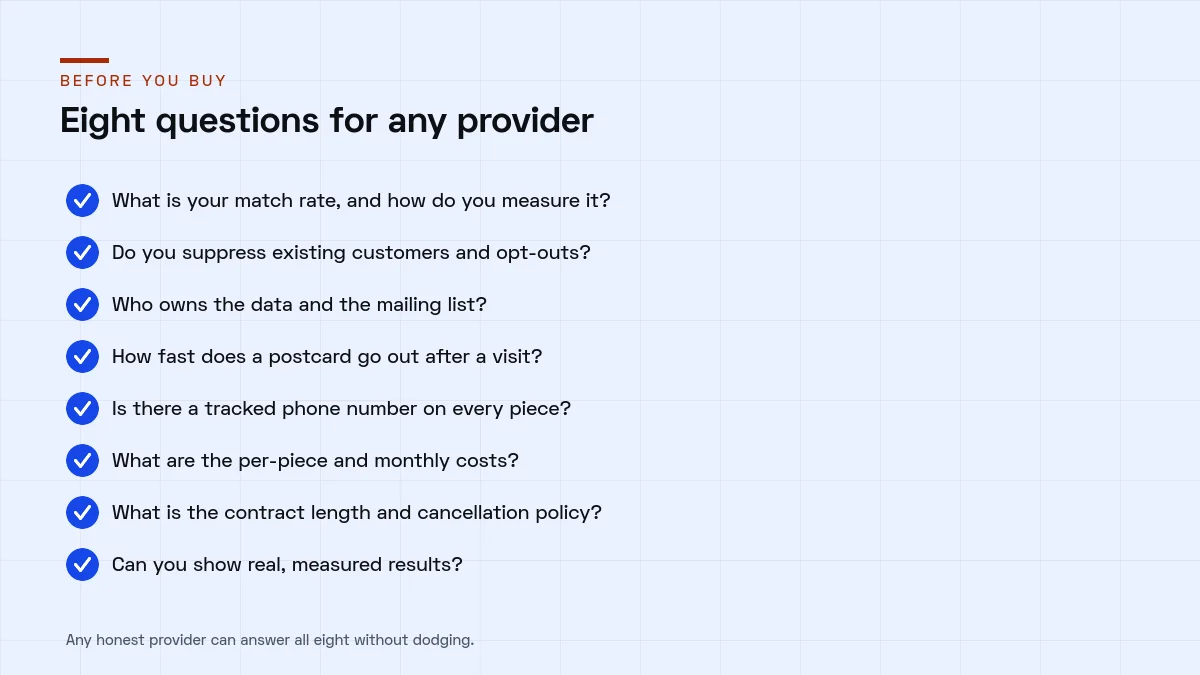
Use this list on any provider you talk to, us included. Ask each question out loud on the sales call and get the answer in writing.
1. Are match rates stated honestly? A provider should tell you what share of visitors it can match, by residential and business visitors, and say plainly that the rest stay anonymous. Be careful with any pitch that implies every visitor gets a postcard. Ask which data setup a quoted rate is based on.
2. Does every campaign use a tracked phone number and a QR code? A number that exists only for one campaign is how you know a call came from the postcard. Without it, you are guessing. Ask to see a sample call report.
3. Does the lead go into your CRM with a follow-up sequence? A scan or call should land in your CRM and start a follow-up sequence. Ask which CRMs they connect to and who writes the follow-up messages.
4. Are existing customers and opt-outs suppressed? You do not want to mail a customer who just paid you, and you must honor people who ask not to be contacted. Ask how your customer list is uploaded for suppression, and how opt-out requests are recorded and honored.
5. Who owns the data? Ask who owns the visitor records and matched addresses, and what happens to that data if you cancel. Ask how the provider handles privacy notices on your site and state privacy laws.
6. What are the contract terms? Ask about setup fees, monthly fees, minimum terms, cancellation, and whether postage and printing are billed separately. Ask whether prepaid mail credits expire and when.
7. Are postcard costs shown per piece? You should see a per-postcard price for each mail class and each volume level, so you can compare offers line by line.
8. How fast does the mail go out? Ask how many days pass between a visit and the mail drop, and which mail class is used. First class and marketing mail can differ by a week or more.
Where SignalForge Fits
SignalForge is our direct mail follow-up service for home service companies in Atlanta and the Southeast. It mails a postcard to website visitors who looked at your services and left without calling, using the Track, Trigger, Mail and Book steps described above. You can read the four-step SignalForge process on the service page.
Here is how it measures against the list above:
- Match rates: we state them up front. About 20 to 25 percent of residential visitors on the base data setup, 60 to 70 percent with a premium data match, and 25 to 35 percent of business visitors. The rest stay anonymous.
- Tracking: every postcard carries a QR code and a phone number that exists only for that campaign.
- CRM follow-up: the scan or call lands in your CRM and a follow-up sequence starts.
- Costs shown separately: plan fees, postcard credits and visitor data are each billed on their own lines.
- Suppression, data ownership and contract terms:
SignalForge plans
| Plan | Setup | Monthly | Notes |
|---|---|---|---|
| Done With You | $1,550 | $152 | Six weekly 50-minute Q&A sessions on Zoom. Embers add-on: $154 a month plus $306 one-time setup |
| Done For You | $3,610 | $461 | Embers included |
| Done For You Elite | $7,730 | $873 | Up to 3 campaigns, Embers included |
Embers is the part that mails website visitors who left. Without Embers, campaigns run off a QR code and a tracked phone number. Postcards are never included in a plan. They come from prepaid mail credits at the prices in the cost section, and visitor data is billed at cost up to the monthly budget you set. The SignalForge plan and postcard pricing section has the current details, and the Embers details explain the visitor mailing piece.
SignalForge Pilot Results
Frequently Asked Questions About Direct Mail Retargeting
What is direct mail retargeting?
It is mailing a postcard or letter to people who visited your website and left without contacting you. A script on your site records the visit, the visitor is matched to a mailing address where possible, and a printed piece goes out a few days later.
Does direct mail retargeting work for home service companies?
It can, and the only way to know for your company is to test it with tracked numbers. As a reference point, we plan a cold prospect list at roughly 1 to 3 percent response, and explain why in our direct mail response rate benchmarks. Home service companies may see more value than most because one booked job can be large.
How do you get a website visitor’s mailing address?
A script on your site notes the visit, and a data provider tries to match that visitor to a mailing address. Matching is imperfect. On our setups, about 20 to 25 percent of residential visitors are identified on the base data setup and 60 to 70 percent with a premium data match. Everyone else stays anonymous.
Is direct mail retargeting legal?
Mailing a postcard to a matched address is generally treated differently from calls and texts, which have their own consent rules under laws such as the TCPA. State privacy laws can still apply to how visitor data is collected and used, so your website should have an accurate privacy notice, and you should honor opt-out requests. Talk to your own attorney about your state.
How much does direct mail retargeting cost?
Plan for three costs: a service fee, the postcards, and the visitor data. With SignalForge, a 6×9 postcard costs $0.95 to $1.13 depending on mail class, plan, and how many credits you buy, and 500 postcards run about $535 to $565. Plans start at $1,550 setup and $152 a month, and visitor data is billed at cost up to a budget you set.
Is Direct Mail Retargeting Right for Your Company?
If your site gets a few hundred visitors a month and your average job is large enough to cover a test, direct mail retargeting can give you a second shot at homeowners who were already shopping. Start by measuring what your site may be leaking with our leak and break-even calculator, then hold any provider to the eight questions above.
When you are ready to talk numbers for your trade and service area, book a call about SignalForge postcard follow-up and we will walk through plans, mail credits and a realistic first campaign with you.