
Website visitor identification puts a mailing address, and sometimes a name, to some of the people who visit your website without calling or filling out a form. For a home service company, it can turn part of your anonymous traffic into a short list of local households you can follow up with. This page covers what it is, how it works, what match rates look like and where the limits are.
Website Visitor Identification Definition
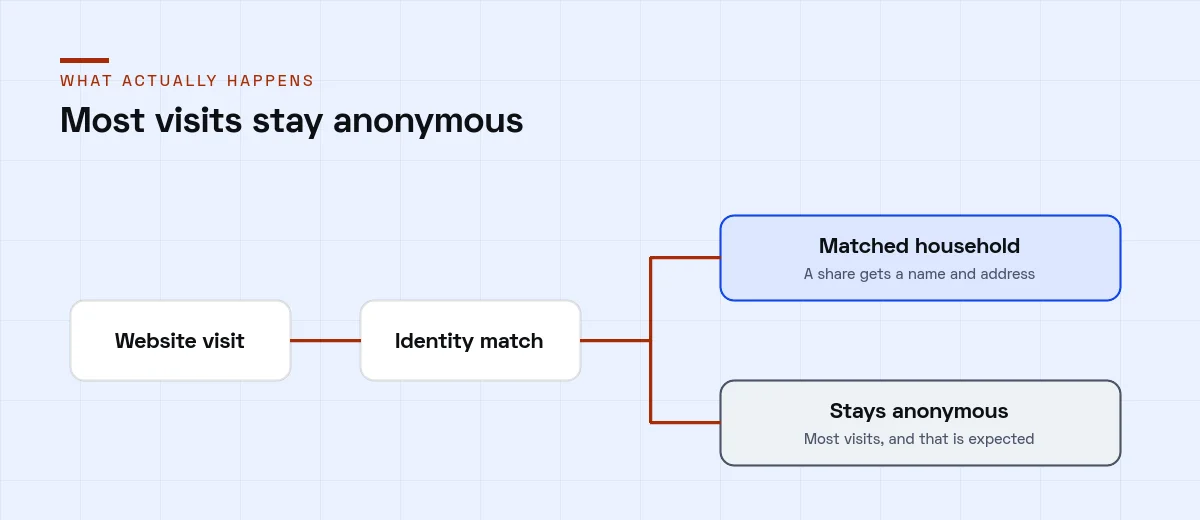
Website visitor identification is the practice of matching a website visit to a real household, person or business using outside data. A small script on your site records details about the visit, and a data provider compares those details with records it already holds. When there is a likely match, you get a postal address and sometimes a name. When there is no match, the visitor stays anonymous.
Why Website Visitor Identification Matters
Many people who look at your services online never call. Someone reads your water heater replacement page on a Tuesday night, checks the price range, and closes the tab. Your analytics shows a visit and nothing you can act on. You already paid to bring that person to your site through ads or search rankings, and the visit ends with no way to reach them. Visitor identification gives you a second chance with a portion of those people. A matched household can get a postcard about the exact service they looked at, and the visit history shows which of your pages draw real interest from your area.
How Website Visitor Identification Works
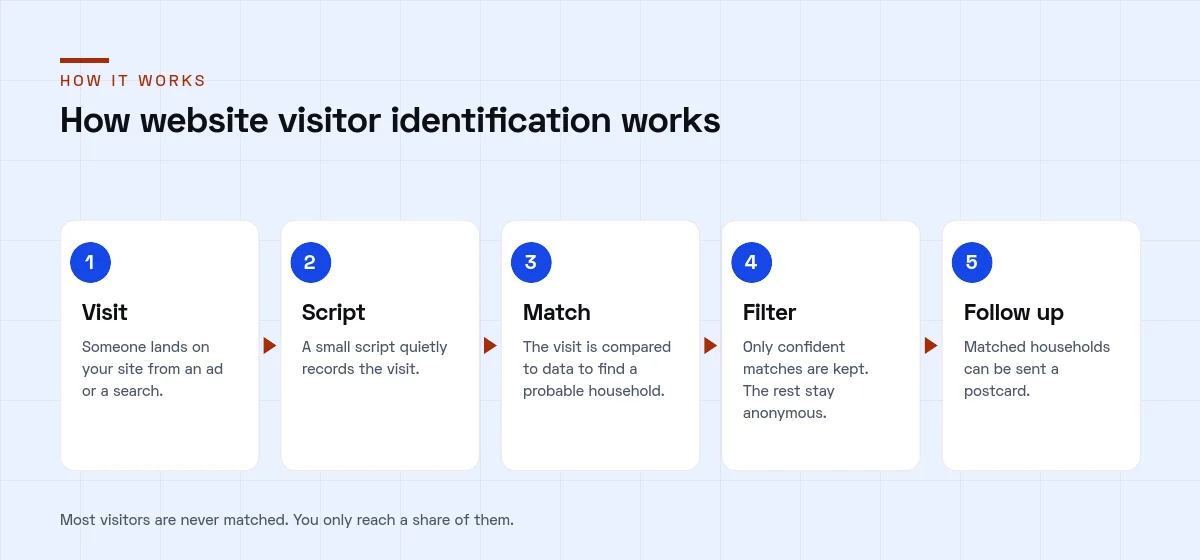
- A script records the visit. A few lines of code on your site note which pages each visitor views, when they visited, their IP address and basic browser and device details.
- The visit is compared with third-party data. A data provider checks those signals against consumer and business records it licenses from other sources. This is where a visit can be tied to a household or a company.
- The match is a probability. Identification is probabilistic. A shared Wi-Fi network, a phone on a cellular connection or a VPN can point to the wrong address or to no one. Any match should be treated as likely, never certain.
- Matched records are filtered. A careful setup can remove existing customers, people who have opted out of mail and addresses outside your service area before anything else happens.
- The match feeds a follow-up. The household might get a postcard, a call from your team or nothing at all if they do not fit. The pages they viewed tell you which service to mention.
What Match Rates Look Like
No tool names every visitor. For SignalForge, the direct mail follow-up we run for home service companies, identification rates are:
- about 20 to 25 percent of residential visitors on the base data setup
- 60 to 70 percent with a premium data match
- 25 to 35 percent of business visitors
The data type is chosen per campaign. The rest of visitors stay anonymous. Visitor data is billed per visitor named, at cost, up to a monthly lead budget the client sets. If a vendor promises to identify every visitor to your site, ask how they measure it.
Company-Level vs Household-Level Identification
Company-level identification matches a visit to a business, often through the IP address of an office network. That works for a commercial contractor selling to property managers. Household-level identification matches a visit to a home address, which is what most residential service companies need. Household matching relies on more personal data and carries more privacy obligations.
Privacy, Notice and Opt-Out
Visitor identification depends on data that third parties collect and sell, often called data brokers. The Federal Trade Commission studied that industry in its report Data Brokers: A Call for Transparency and Accountability and found that brokers gather consumer information largely out of view of the people it describes. That is why disclosure matters.
If you use website visitor identification, your privacy policy should explain it in plain language, say what data is collected and give people an easy way to opt out of mail. Some state privacy laws add specific notice and opt-out duties, and the rules differ by state.
Website Visitor Identification Examples
These are illustrations built from the rates above. They are not client results.
Illustration 1: A residential plumbing company. In a month, 1,000 people view the plumber’s service pages and leave without calling. At the base residential rate of about 20 to 25 percent, roughly 200 to 250 of those visits might be matched to a household. The other 750 to 800 stay anonymous. The plumber filters out current customers and addresses outside the service area, then mails the rest.
Illustration 2: A commercial HVAC contractor. The contractor gets 200 visits from people at local businesses. At 25 to 35 percent, about 50 to 70 might be matched to a company name and address. A match tells the contractor which business looked. It does not say which person at that business was browsing.
Illustration 3: A roofing company after a storm. Traffic jumps after a hail storm, so the roofer runs a campaign with a premium data match, which can identify 60 to 70 percent of residential visitors. More matches mean a larger data bill, since visitor data is billed per visitor named. The roofer sets a monthly lead budget so the cost stays capped.
Related Terms
- Direct mail retargeting: mailing a postcard to people who visited your site and left, using visitor identification to find the address.
- Answer engine optimization: shaping your online information so AI assistants name your business, which can send new visitors to your site.
- Conversion rate: the share of website visitors who call or book, and the number visitor follow-up aims to raise.
- Local search intent: signs that a searcher wants a provider nearby, which makes service page visitors worth following up.
- Near me search: searches like “plumber near me” that bring ready-to-hire homeowners to your pages.
- Zero-click search: searches answered right on the results page, which make each real site visit count for more.
Frequently Asked Questions About Website Visitor Identification
Is website visitor identification legal?
It can be used legally in the US when it follows privacy laws, which vary by state. In general that means a clear privacy notice on your site, a working opt-out and data sourced from providers that follow those laws. Rules for company-level and household-level identification can differ.
How accurate is website visitor identification?
It matches only some visits, and each match is a probability. On SignalForge, rates are about 20 to 25 percent of residential visitors on the base data setup, 60 to 70 percent with a premium data match and 25 to 35 percent of business visitors. Shared networks, phones and VPNs can cause misses or wrong matches.
Can Google Analytics tell me who visited my website?
No. Google Analytics reports visits in totals, such as pages viewed and traffic sources, and it does not name visitors. Putting a name or address to a visit requires a separate identification tool that uses third-party data.
What is the difference between company and person identification?
Company identification matches a visit to a business, usually through an office IP address. Person or household identification matches a visit to a specific home address and relies on more personal data. Residential service companies usually need the household version.
Do visitors know they are being identified?
They should be told. Your privacy policy should describe visitor identification and how to opt out of mail, and some state laws set specific notice requirements.
If you want matched visitors to hear from you while the job is still open, see how a postcard can follow up with households that browsed and left.