
How much does direct mail cost for a home service company? The honest answer is a range, and the cheap end of the range you see online usually describes a different kind of mail than the postcard you probably want to send. Two quotes can both be accurate and still sit far apart, because they price different things.
This guide explains why quotes vary and what each part of the cost pays for. Then it shows how to set a monthly budget, with every step of the math written out. We plan and run postcard follow-up for home service companies in Atlanta and the Southeast, so from step 2 on we use our own current prices as a worked example. You can swap in any quote you collect and run the same math.
How much does direct mail cost? Why quotes are so far apart
Many of the low per-piece figures published online describe one of two things.
The first is saturation mail. With USPS Every Door Direct Mail, you pick carrier routes and a piece goes to every address on those routes. You do not need names or a mailing list, which keeps the price per piece low.
The second is a large bulk run of small cards. Print cost per card drops as the run gets bigger, so a quote for tens of thousands of small cards can look very cheap per piece.
A home service owner often wants something else: a 6×9 postcard addressed to one specific household, printed and mailed in small batches every week or month. That card costs more per piece. Each one needs its own name and address, and it prints in smaller runs. So before you compare direct mail cost per piece, decide what kind of mail you are pricing.
| Type of mail | Who gets it | What you need | Price per piece |
|---|---|---|---|
| Saturation (EDDM) | Every address on the routes you pick | A route map and a design | Usually the lowest, about $0.26 postage |
| Bulk list mail | Everyone on a list you buy or rent | A list and a large print run | Low to moderate at high volume |
| Addressed, small-batch mail | Specific households, such as people who already looked at your services | A name and address per card, plus tracking | Higher per piece |
Step 1: Decide who should get the mail
Start with the audience, because it drives every other cost.
Saturation mail reaches every door on a route. That includes renters and people who just replaced their roof. The postage is cheap, about $0.26 per piece for USPS Every Door Direct Mail, but many of those pieces reach homes with no current need.
A purchased list narrows the audience. You might pick homeowners in certain ZIP codes or homes past a certain age. You pay for the list, and the cards cost more because each one is addressed.
Your own customer list costs nothing to rent. It works well for seasonal reminders and repeat work.
The narrowest audience is people who already showed interest, such as homeowners who visited your service pages and left without calling. Each card costs more, and each one goes to a household that was looking at your services recently.
So keep two numbers in mind. Price per piece is one. Price per household that may need you this month is the other, and that second number is usually the one that decides whether mail pays off.
Illustration: if you mail 2,000 homes on a route and only a small share of them need a water heater this year, most of that spend reaches homes with no need, even at a low price per card.
Step 2: Price the postcard itself
Postcard mailing cost is the biggest line in most mail budgets. Its price depends on size, print quality, quantity and the postage class.
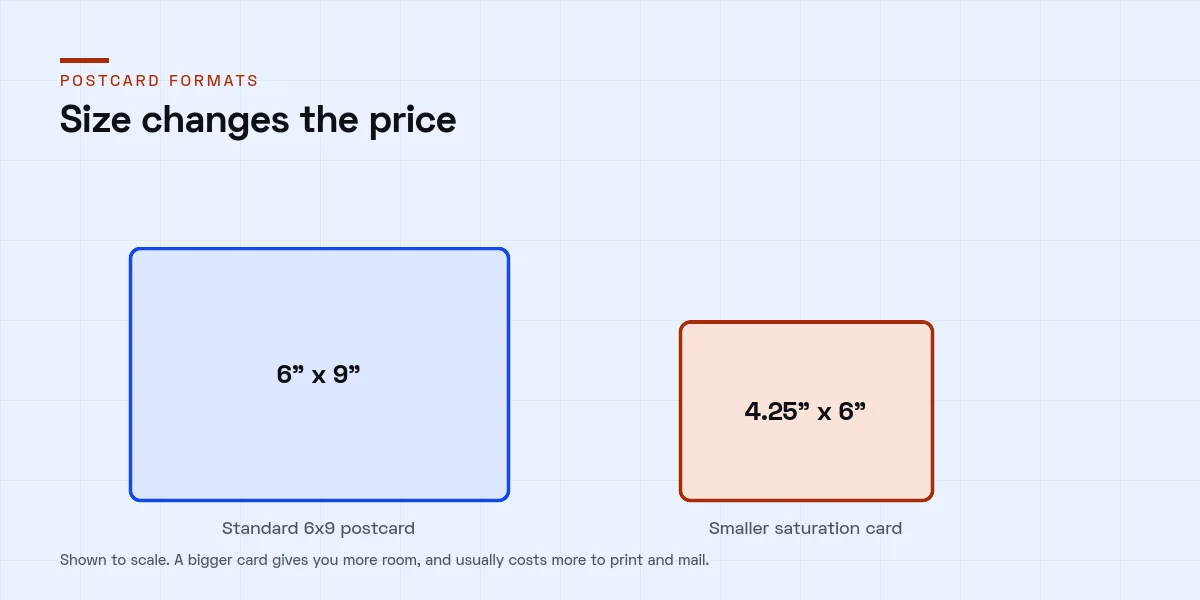
Size. A 6×9 card gives you room for a photo, an offer, a QR code and a phone number. Card size can also change the postage price, so check the USPS size rules for the class you plan to use before you compare two quotes.
Quantity. Larger orders lower the price per card. Small weekly batches cost more per card than one big run.
Bundled or separate. Some quotes include printing and postage in one price. Others list printing only and add postage later. Ask every vendor which one you are looking at.
Worked example: our current mail credit prices
Here is how this looks with real numbers. These are Social Linus’s current prices for SignalForge mail credits, per 6×9 postcard. Postcards are never included in a plan. Clients buy prepaid mail credits from their own budget. On Done For You plans the price per card drops as the block gets bigger, and Done With You pays the Flex price at any volume.
| Purchase | First class | Marketing mail |
|---|---|---|
| Flex (100 to 2,499) | $1.13 | $1.07 |
| Growth block (2,500) | $1.09 | $1.03 |
| Scale block (5,000) | $1.05 | $0.99 |
| Summit block (10,000) | $1.01 | $0.95 |
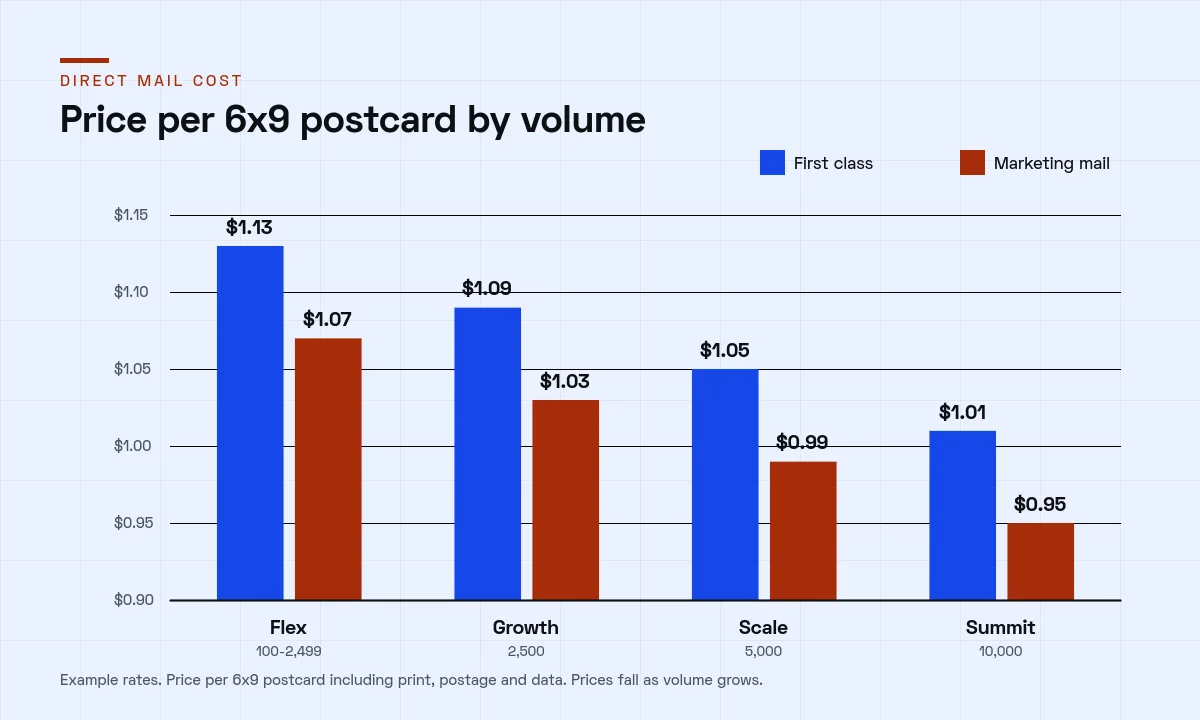
Each credit covers printing and postage for one card, and credits are bought for one mail class at a time. The full range is $0.95 to $1.13 per card. 500 postcards run about $535 to $565. Credits expire 12 months after purchase, so buy a block you will use within a year. A campaign that mails automatically needs at least 100 credits in its balance to keep sending. You can see our current mail credit prices next to each plan, and every format on our direct mail price list.
Step 3: Choose a postage class
Most home service postcards go out as either first class mail or marketing mail. The trade is speed against price.
- First class arrives in about 3 to 5 business days.
- Marketing mail arrives in about 7 to 21 business days.
Both count from the day USPS receives the mail, usually within 2 business days of when you submit the campaign. In our price list, first class costs 6 cents more per card at every block. On 1,000 cards in the Flex block, that is $1,130 for first class ($1.13 × 1,000) against $1,070 for marketing mail ($1.07 × 1,000), a difference of $60.
Speed matters most when the card follows up on recent interest. A homeowner who looked at your AC repair page on Monday may book someone by Friday. For a seasonal reminder to past customers, the slower class may be fine.
If you are pricing postage on your own, use the current USPS postage price page instead of a figure from an old blog post. Postage prices change, and the class, size and sort level all affect the rate.
Step 4: Add list or data, design and tracking
Printing and postage are the visible costs. These three lines sit around them and can change the total.
List or data
Saturation mail needs no list. A rented or purchased list is usually priced per record, so ask for the price per name and how recently the list was updated.
If you mail website visitors, the data cost works differently. With SignalForge, a small script notes which pages each visitor looked at. When someone views a service page and leaves without calling, SignalForge tries to match them to a mailing address. Visitor data is billed per visitor named, at cost, up to a monthly lead budget you set. Matching is imperfect, and the rest of visitors stay anonymous. The identification rates we use for planning are:
- about 20 to 25 percent of residential visitors on the base data setup
- 60 to 70 percent with a premium data match
- 25 to 35 percent of business visitors
The data type is chosen per campaign. It is not tied to a plan. For more on how this kind of follow-up works, read what direct mail retargeting is and when it fits.
Design
Design can be a one-time cost or part of a service fee. Ask whether changes to the card cost extra, and how many versions you get. A card for AC repair and a card for furnace replacement may need different photos and offers.
Tracking
Tracking is what lets you judge the cost later. Without it, you have a mail bill and a guess. Each SignalForge card carries a QR code and a phone number that exists only for that campaign, so you know which postcard made the call. The scan or call lands in your CRM and a follow-up sequence starts.
Step 5: Build a budget you can test
Pick a monthly volume you can hold for at least a few months, so you have enough cards out to judge the result. Here is a simple example: 250 postcards a month for 6 months, which is 1,500 postcards in total. All prices come from our credit table in step 2.
Illustration: on the base data setup, 250 named residential visitors a month would take roughly 1,000 to 1,250 residential visitors who viewed a service page and left (250 ÷ 0.25 = 1,000 and 250 ÷ 0.20 = 1,250). Your own numbers will differ.
Option A: buy Flex credits each month
Each month you buy 250 credits, which falls in the Flex range (100 to 2,499).
- First class: 250 × $1.13 = $282.50 a month. Over 6 months: $282.50 × 6 = $1,695.
- Marketing mail: 250 × $1.07 = $267.50 a month. Over 6 months: $267.50 × 6 = $1,605.
Option B: buy a Growth block up front
You buy 2,500 credits at once. That covers these 1,500 cards and 1,000 more, so the block only pays off if you keep mailing about 250 a month for 10 months, inside the 12-month expiry window. This option is for Done For You plans, since Done With You pays the Flex price at any volume.
- First class: 2,500 × $1.09 = $2,725 up front. The 1,500 cards used in these six months cost 1,500 × $1.09 = $1,635.
- Marketing mail: 2,500 × $1.03 = $2,575 up front. The 1,500 cards used in these six months cost 1,500 × $1.03 = $1,545.
Option B saves $60 over six months in either class ($1,695 minus $1,635, and $1,605 minus $1,545), because the Growth block takes 4 cents off each 6×9 card. It also ties up $2,725 or $2,575 at the start, and the savings hold only if you mail the other 1,000 cards within the year. For a first test, Option A keeps the risk smaller. Once you know the mail works, Option B is the cheaper way to keep going.
Add the plan fee and visitor data
Plan fees are separate from postcards. Using our current plans, six months looks like this:
- Done With You with the Embers™ add-on: setup $1,550 + $306 = $1,856. Monthly $152 + $154 = $306, and $306 × 6 = $1,836. Six-month total: $1,856 + $1,836 = $3,692.
- Done For You (Embers included): setup $3,610. Monthly $461 × 6 = $2,766. Six-month total: $3,610 + $2,766 = $6,376.
Add your postcards from Option A or B, plus visitor data at cost up to the monthly lead budget you set. For example, Done For You with Option A first class comes to $6,376 + $1,695 = $8,071 before visitor data.
Work out how many jobs cover it
Divide the total by the gross profit on an average job, then round up.
Illustration: if an average booked job leaves $1,000 in gross profit, the $1,695 of postcards in Option A first class needs 2 booked jobs to cover it ($1,695 ÷ $1,000 = 1.7, rounded up to 2). Use your own job value here.
To run this with your traffic and your job values, try the Direct Mail ROI Calculator. It estimates how many visitors could be named, what the cards would cost and how many jobs cover the spend.
Frequently asked questions about direct mail cost
How much does it cost to mail 500 postcards?
On our current SignalForge credit prices, 500 6×9 postcards run about $535 to $565. That is $535 for marketing mail (500 × $1.07) and $565 for first class (500 × $1.13) in the Flex block. Other vendors price differently, so ask whether a quote includes postage.
How much does it cost to send 1,000 postcards?
At 1,000 credits, still in the Flex block, our price is $1,070 for marketing mail (1,000 × $1.07) or $1,130 for first class (1,000 × $1.13). A saturation mailing of 1,000 smaller cards will usually cost less per piece, because it needs no names and goes to every door on a route.
What is the average cost of a direct mail piece?
There is no single average that fits every kind of mail. Saturation mail and large bulk runs of small cards sit at the low end. Addressed 6×9 postcards mailed in small batches cost more per piece. Compare quotes for the same size, postage class and audience before you decide one is cheap.
Is direct mail cost effective for a home service business?
It can be, when the cards reach households likely to need you and a booked job is worth enough to cover the spend. Published response rates disagree. Our review of where direct mail response rates come from suggests planning a cold prospect list at roughly 1 to 3 percent response, and a list of existing customers higher than that. Your own break-even math matters more than any average.
What is the cheapest way to send direct mail?
Saturation mail through USPS Every Door Direct Mail is usually the lowest price per piece, because no list or names are needed. The trade-off is that you pay to reach every home on the route, including homes that will never need your service. Check current prices on the USPS site before you budget.
The bottom line
Direct mail cost depends first on who you mail. Saturation and bulk runs give the lowest price per piece. Addressed, small-batch postcards cost more per card and reach a narrower group. Price the card, pick a postage class, then add list or data, design and tracking. Build a six-month budget with the math written out, and divide it by your job profit to see how many jobs cover it.
If you are weighing mail follow-up for a home service company, our buyer’s guide to direct mail retargeting for home services covers what to ask a provider. When you are ready to price follow-up mail for your own site, compare the three SignalForge plans and mail credit blocks, or start with your own numbers in the direct mail return calculator.